
Guide · Retaining walls
Garden and seat walls
Seat walls, bed edges and raised planters set the structure of a garden. They follow the same construction rules as a wall several times their height.
What a low wall is for
At garden scale, retaining wall installation is mostly a design tool. A short wall marks where lawn ends and planting begins. It frames a patio, adds levels to flat ground and provides seating without furniture. Those edges do more for how finished a property reads than almost anything else.
None of that makes them ornamental. Wet clay pressing on a 600mm wall all winter is a structural load, and a wall with nothing draining behind it will lean just like a tall one.
The types
- Seat wall. Built at sitting height around a patio, with a cap deep enough to sit on comfortably. Few single additions make an outdoor room more usable.
- Bed edge. One or two courses raising planting above lawn or paving. Soil stays in the bed and the mower gets a clean line.
- Raised planter. Taller, holding real soil depth. Planting comes up to eye and hand level, which matters to anyone who prefers not to kneel.
- Terrace wall. A pair of short walls replacing one tall one, with a bed between. The slope grading guide explains when that split works.
- Freestanding screen or pillar. No retained soil, so the structural case differs, but base and cap rules still apply.
Getting the heights right
Seat walls are where height errors show first. The usual miss is about fifty millimetres, because nobody counted the cap. Set the finished cap surface near dining-chair height and size the cap depth for comfort.
Bed edges need just enough height to contain mulch and read as an intended line. Go much taller and the edge becomes a trip hazard rather than a border.
Raised planter depth should follow what will grow in it. Annuals need a shallow bed, while a shrub or small tree needs far more. Choosing a round number of courses first is how planters end up too shallow for the root ball.
Same construction, smaller scale
Retained soil exerts pressure regardless of how short the wall is. The base, drainage and backfill sequence is therefore unchanged, and the retaining walls hub sets it out in full. What differs at this size is the use above grade: people sit on these walls, lean on them and set things down on the cap.
The cap is the piece people touch
On a seat wall, the cap sets the standard for everything below it. Check for a consistent overhang end to end, tight joints, a top flat enough that a glass sits still, and an eased front edge. A steady overhang throws rain clear of the face and casts a crisp shadow line. That shadow is much of what separates a built wall from a stacked one.
Relating wall to paving
A wall in the paving's exact unit and colour tends to disappear. Natural stone beside concrete pavers, or a cap that picks up the border tone, gives the edge its own identity.
In practice
Where garden walls earn their place
Around a patio
Defines the outdoor room and supplies extra seating for gatherings.
At the foot of a slope
A short wall turns an awkward bank into a level bed worth planting.
Along a driveway
Keeps a neighbour's higher soil off the pavers at the lot line.
Flanking steps
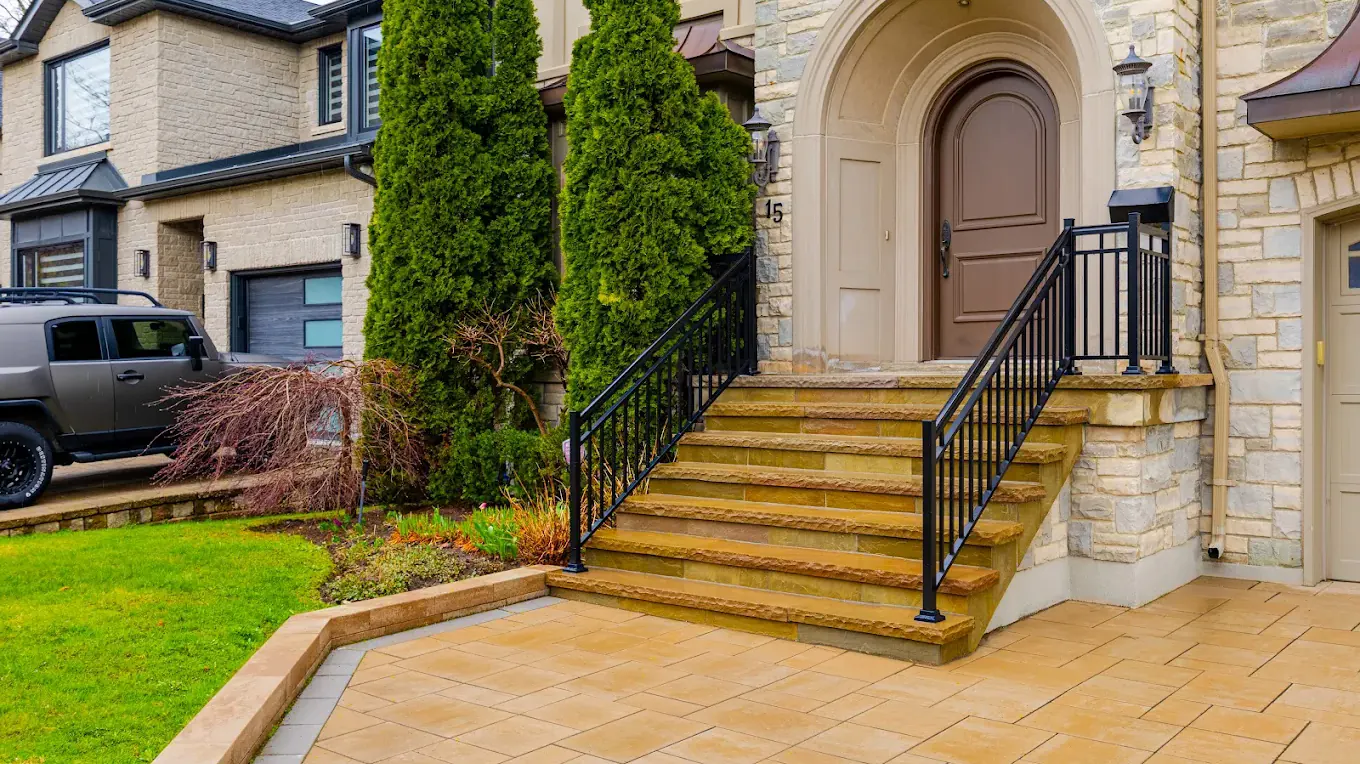
Cheek walls beside a flight frame the entrance and give a railing a logical anchor.
Around a tree
A raised ring holds mulch above lawn level and keeps trimmers off the trunk.
As a terrace pair
Two short walls with planting between, gentler on the eye than one tall face.
Questions
Garden wall questions
What height should a seat wall be?
Roughly 450mm to the top of the finished cap, close to dining-chair height. Measure that to the cap surface, not the last block course, or the wall ends up low. A cap about 300mm to 400mm deep sits comfortably and still leaves room for a glass.
Does a low garden wall still need drainage behind it?
Yes, whenever it retains soil. A 600mm wall holding saturated clay carries a genuine load, and without clean stone and fabric it will tip forward over a few winters. The drainage materials behind a short wall add little to the job. A freestanding wall with soil on neither side is the exception.
Can a garden wall sit directly on the soil?
No. Even a two-course edge needs a compacted granular base with its first course below finished grade. Topsoil settles unevenly within a season, and every course above inherits that movement. The base is the one layer you cannot fix afterwards without rebuilding.
Should the wall match the paving?
Complement it rather than copy it. A wall in the identical unit and colour tends to vanish into the floor. Contrast in material, such as natural stone beside concrete pavers, or a cap that echoes the border, gives the edge definition.