
Guide · Driveways
Driveway design that answers to the house
Vehicles, doors and the route to the entrance fix the shape of a driveway. Pattern and colour come afterwards. This guide covers the decisions a drawing should settle first.
Function sets the shape
Layout starts with vehicles because vehicles do not forgive bad geometry. A driveway that forces a three-point turn every morning fails its owner, however good the stonework is.
- Width per vehicle, door swing and a walking lane. The lane is the item most often dropped. A worn track in the lawn beside the drive is the evidence.
- Room to turn while moving. Steering a stationary car grinds the tyre into the pavers. Space to turn while rolling keeps that wear off the surface.
- Where doors open. A wall or planting bed exactly where the passenger door swings makes a driveway that meets the dimension and fails in use.
- Where the bins go. Waste and recycling bins need a defined pad. Left unplanned, they end up on the lawn or across a parking space.
- The route to the front door. Decide whether the walkway leaves from the driveway or the street. The junction should be drawn, not left where two scopes happen to meet.
Composition: making a large field read as one surface
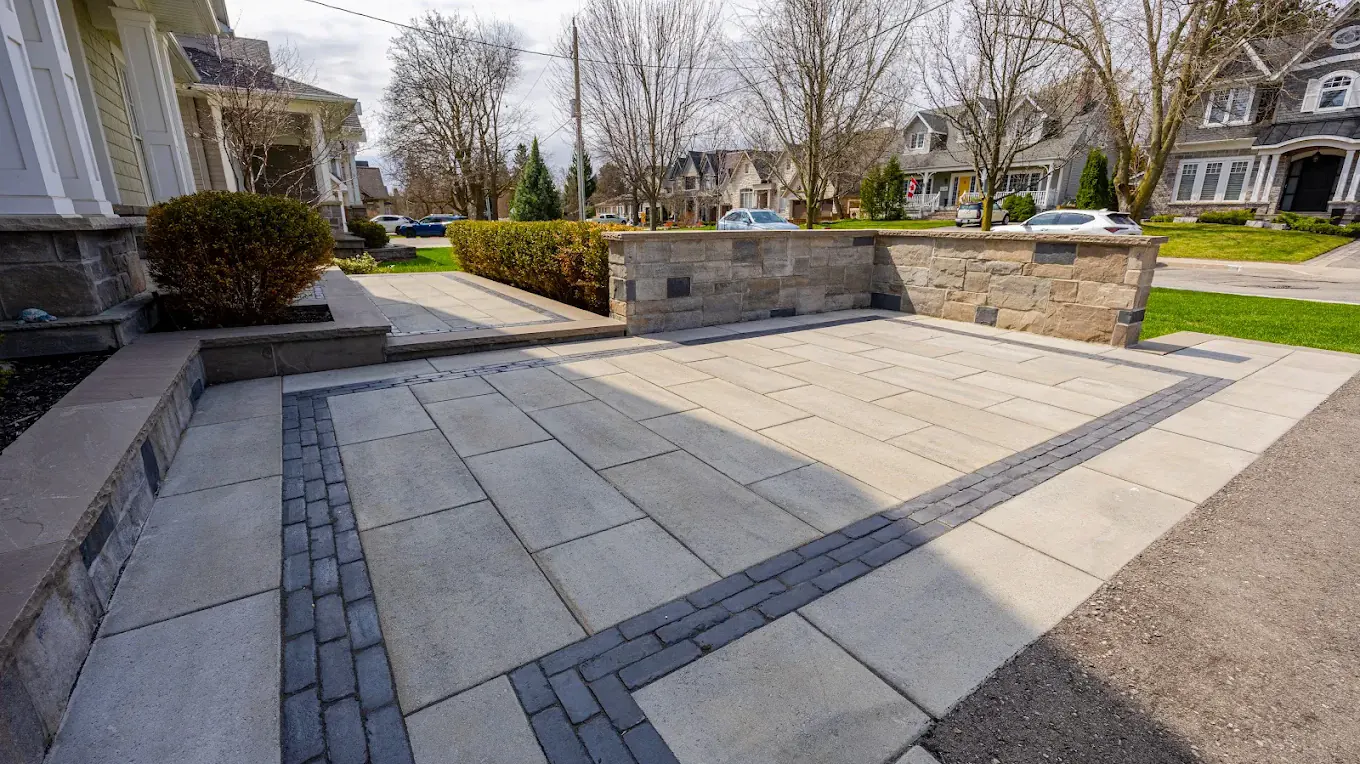
With the geometry fixed, the remaining problem is scale. A driveway is a broad flat rectangle aimed at the street, and untreated it reads as exactly that. Driveway interlocking pavers give a small vocabulary for breaking it down: border, band, unit size, colour and edge.
The border
A soldier course around the perimeter frames the field and gathers the perimeter cuts into one intentional line. A double border carries more weight and suits a large field. Charcoal against a lighter field is the most dependable combination.
Accent bands
A band laid across the driveway divides one rectangle into two related shapes. Place it at the walkway junction or where the approach becomes parking. On a long drive, a band is the most effective way to shorten how the surface reads.
Field material and unit size
Large-format slabs read quiet and contemporary across a big area, with fewer joint lines. Smaller pavers add texture, tighter bracing between units and tolerance for a site that is not quite flat. Cobble-scale units work well as bands and borders but make a laborious full field.
Colour, held to two
Two colours, and at most a narrow accent. Judge them against the actual brick, stone, roof and trim, in daylight, both wet and dry. Concrete pavers weather slightly lighter than the sample, and early efflorescence can leave the first year looking patchy.
The street edge
The metre where the driveway meets the municipal apron is seen more than any other. It needs a deliberate end: the border carried through, a straight saw cut and a flush level with no lip.
Planting with real depth
A 300mm soil strip between paving and fence supports weeds and little else. Size beds at layout so planting can establish and the frontage keeps some green.
Where design meets construction
Two layout decisions carry structural consequences:
Free edges. Any perimeter not held by a wall, curb or foundation needs restraint fixed into the base. More unrestrained edge in a design means more places for the field to creep. The driveways overview explains why turning loads make this critical.
Inset details. Grass strips, gravel bands, channel drains and light fixtures all interrupt the field. Each needs its own restraint and detail, or it becomes the seam the paving opens along.
Look for these
Signs a driveway was designed, not just laid
Cuts kept out of sight
Full units in the sightlines, cuts absorbed into the border, and nothing slimmer than about a third of a unit.
Borders that carry through
One border detail running from driveway to walkway to entrance landing.
Joint lines with intent
Pattern square to the house front or at a chosen angle, never drifting in between.
A drawn junction
A designed transition where walkway meets driveway, not two fields butted together.
Beds that can grow
Planting areas wide enough to hold something, not leftovers from the paving.
A clean street line
A straight, flush, deliberate end at the municipal edge.
Questions
Driveway layout questions
How wide should a driveway be?
Wide enough that every door opens fully with room to walk past. Car width plus a token margin falls short. With two cars parked side by side, the inner doors need that clearance too. If people walk up the driveway to the entrance, add a separate walking lane.
Herringbone or running bond for a driveway?
Herringbone, at ninety or forty-five degrees, gives the strongest interlocking action because each unit braces its neighbours in two directions. Running bond and slab formats read calmer and perform well on a residential drive with a properly built base. The forty-five degree version adds perimeter cuts and labour.
Can grass or gravel strips run through the driveway?
Yes, as a designed detail with edge restraint along both sides. An unrestrained strip becomes the line the paving spreads from. Plan for snow clearing as well, because a plough blade will catch the strip.
Can the paving pattern continue past the property line?
Only where the municipality allows it, since the apron is usually municipal land. Rules on finishes and curb cuts differ from one municipality to the next. Where the pattern must stop, the border is designed to end it cleanly at the line.