
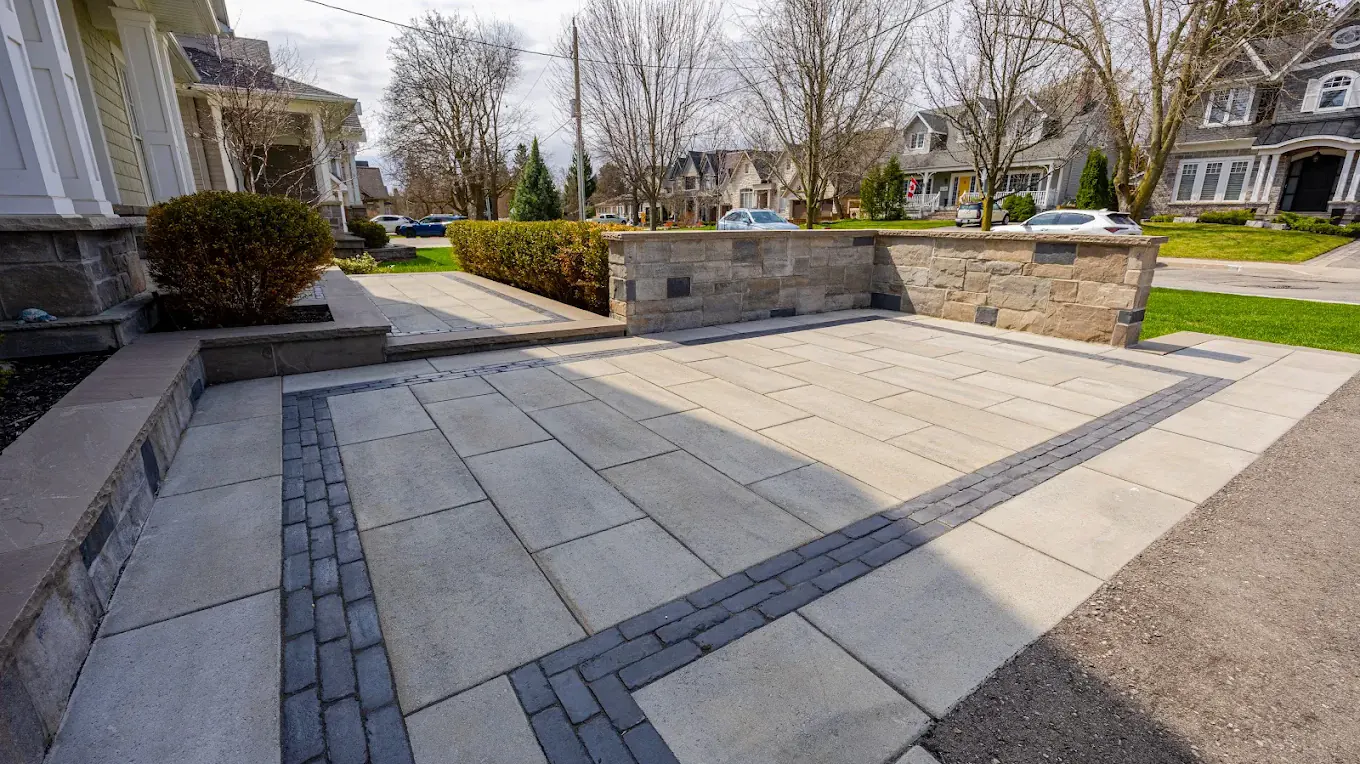
Driveways
Paver driveway installation, built for the load it carries
A driveway takes concentrated vehicle loads in the same tracks every day, and it is the first surface anyone sees. We excavate for the vehicle, drain the surface away from the building and restrain every free edge.
Load and appearance, solved together
Paver driveway installation answers two briefs at once. The surface has to carry a vehicle through every freeze-thaw cycle, and it is also the largest material plane in front of the house. Most failed driveways were designed around one of those briefs and ignored the other.
Design for load alone and you get a serviceable slab with no relationship to the facade. Design for appearance alone and the wheel tracks start sinking within a few winters. Both briefs are resolved below grade, well before a paver is selected. The general base, drainage and frost method is set out on the interlocking page; this page covers what changes when a car sits on it.
What decides whether it lasts
- Excavation depth. Set by the sub-grade once it is exposed and by the load above it. Clay is common in this part of Ontario, and it usually needs more depth than an estimate written before digging allows for.
- Compaction discipline. Granular base goes down in thin lifts, each compacted before the next. Repeated wheel loads find a soft lift quickly, so a driveway exposes a compaction shortcut sooner than any other surface.
- Drainage. A driveway is a broad hard surface, and its runoff needs a planned destination. Where it falls toward a garage, a drain at the low point is usually part of the answer, not grading alone.
- Edge restraint. Turning vehicles push sideways on the long free edges every day. Without restraint fixed into the compacted base, the field creeps outward and the joints open from the perimeter in.
- Turning geometry. Wheels turned on a parked car scrub the pavers. A layout that lets drivers turn while rolling spares the surface and the people using it.
The structural case
A driveway is not a wide patio
The pavers can be identical. What sits beneath them cannot, because a vehicle is a different kind of load.
Concentrated, repeated loads
A patio sees distributed weight from feet and furniture. A driveway sees a vehicle's full mass on four small patches, landing in the same tracks daily. That is a fatigue problem, and fatigue is what a shallow base cannot survive.
Depth spreads the load
Each layer of compacted granular spreads a wheel load wider before it reaches native soil. A base cut to patio depth delivers that load still concentrated, and the sub-grade yields along the tracks.
Compaction under repetition
A patio base mostly has to hold still. A driveway base has to hold under every arrival and departure, which is why each lift is compacted before the next goes down.
Edges that resist a sideways push
Patio edges mainly resist gravity. Driveway edges also take lateral thrust from tyres turning against the same border. Restraint sized for a walkway can give way within a season.
Same unit, different working life
Set into a patio, a paver sees footsteps. Set into a driveway, it is scrubbed by tyres every day. The unit is unchanged between the two jobs; the construction under it is not.
With the base sized for the vehicle, the remaining questions are compositional: borders, bands and the edge at the street. Driveway layout and composition →
In practice
The front of the house as one scope
A driveway rarely stands alone. The front walkway, the entrance steps and the wall holding grade at the lot line usually share its borders and levels. We build them as one scope, in one sequence.
Split across trades and seasons, the stone stops matching and the joint lines drift. A wall added after paving gets improvised around the finished edge. Built together, borders carry through, level changes land where they were drawn, and one drainage plan serves the whole frontage.

Go deeper
Driveway guides
Questions
Driveway questions
Why does a driveway need a deeper base than a patio?
Because a vehicle puts its full weight on four small contact patches and returns to the same tracks every day. A patio spreads foot traffic and furniture loosely across its whole area. That focused, repeated loading fatigues a shallow base until ruts form, so a driveway is excavated well below walkway depth. The final depth is set once the sub-grade is exposed.
Can new pavers go over the old asphalt?
No, the asphalt comes out. It is a failed surface rather than a base, and it traps water in the bedding layer laid over it. Water held under pavers is what lifts them in a hard freeze.
How long is the driveway out of use?
Expect days rather than weeks, with no parking on it for the whole period. Excavation and base work take most of the schedule, and that is when machinery is moving in and out. After the pavers are down, vehicles stay off for a short settling period. Builders should plan site access around the base stage.
Can a paver driveway be ploughed?
Yes, it is cleared like any other driveway. Ask the snow contractor for a plastic-edged blade or rubber plough shoes, since bare steel chips paver edges. Rock salt does not weaken the structure, but it speeds surface scaling on concrete units, so use it sparingly.
What sets the cost of an interlocking driveway?
Mostly what happens below the surface. Excavation depth, the volume of soil hauled away and the granular base the sub-grade demands account for most of the spread between projects. Above grade, unit format, pattern cutting, border detail and drains add to it. A number given before anyone knows the ground is a guess about the largest line item.
Who decides how the apron at the street is finished?
Usually the municipality, because the strip between the property line and the curb is typically municipal land. Permits, curb cuts and permitted finishes are handled differently in each of the five municipalities we work in. We locate that boundary at the site visit and state plainly what falls inside the scope.